

A dispatch from Steamboat Springs, Colorado
What If Carbs Were Never the Problem?Spoiler: they weren't.
America spent 50 years terrified of the wrong ingredient. A short history of how the fight started, and why the comeback runs on a 4:1 carb-to-protein ratio.

First, a confession: we make energy bars for a living, and our bars are mostly carbs. Organic dates, oats, honey, and nuts. So yes, we've got a horse in this race. But stick with us, because the story of how carbs became the bad guy has a lot less to do with your body than it does with somebody's marketing budget.
A brief history of blaming the wrong ingredient
The fear of carbs is older than you'd think. In the 1860s, a London undertaker named William Banting published a pamphlet swearing off bread and potatoes, and it sold so well that "banting" became the Victorian word for dieting. The idea never really left. It just changes outfits every few decades.
Back in the 90s, fat was the villain. Grocery aisles filled up with "fat-free" cookies that were basically sugar in a trench coat, and everybody felt great about it until they didn't. When that era collapsed, the diet industry needed a new bad guy, and carbs drew the short straw. Atkins made bread contraband. Keto put bananas on a watchlist. An entire generation learned to apologize for eating an apple.
Here's the pattern worth noticing: every diet era picks one thing to blame, sells you the fix, and quietly moves on when the next villain tests better with a focus group. The potato never changed. The marketing did.
Wait. Are carbs actually awesome?
Carbohydrates are your body's preferred fuel. Your brain alone burns through roughly 120g of glucose a day. Endurance athletes still load up on carbs before race day, because carbs are what legs run on: every skin track, river mile, and school pickup sprint.
What people think eating carbs does
That's the refined-sugar rap sheet, not the banana's.
What whole-food carbs actually do
Fuel your brain
It burns about 120g of glucose a day
Power your legs
Ask any endurance athlete
Carry fiber
5g per bar, from oats, nuts, and seeds
Burn steady
The 4:1 ratio keeps energy even
So the question was never whether to eat carbs. It was which ones. Because a gas-station candy bar and a date are both "carbs" the way a firework and a campfire are both "fire." One flashes and fizzles. The other keeps you warm all night. Refined sugar shows up alone, hits fast, and drops you just as quick. Whole-food carbs bring friends: fiber, protein, and fat. They burn steady instead of all at once.
Carbs without the buckin' blood sugar rodeo
The amber line is the sugar-spike ride. The white one is whole-food carbs at a 4:1 carb-to-protein ratio, riding steady in the middle lane.
Why We Made This Bar (hint: we wanted real, tasty energy)
Ask a mountain guide or an endurance athlete how they fuel a long day, and you'll hear the same shape of answer: mostly carbs, a little protein, over and over. That's the thinking behind the ratio we build every bar around. 4 parts carbs to 1 part protein, all of it from whole food. The carbs do the work. The protein and fiber keep the burn slow and even.
No added sweeteners means there's no cheap spike at the front and no crash at the back. Just steady energy that lasts from the trailhead to the truck, or from lunch to whenever the 2 PM slump usually finds you. It doesn't anymore, by the way.
Every Bar U Eat bar
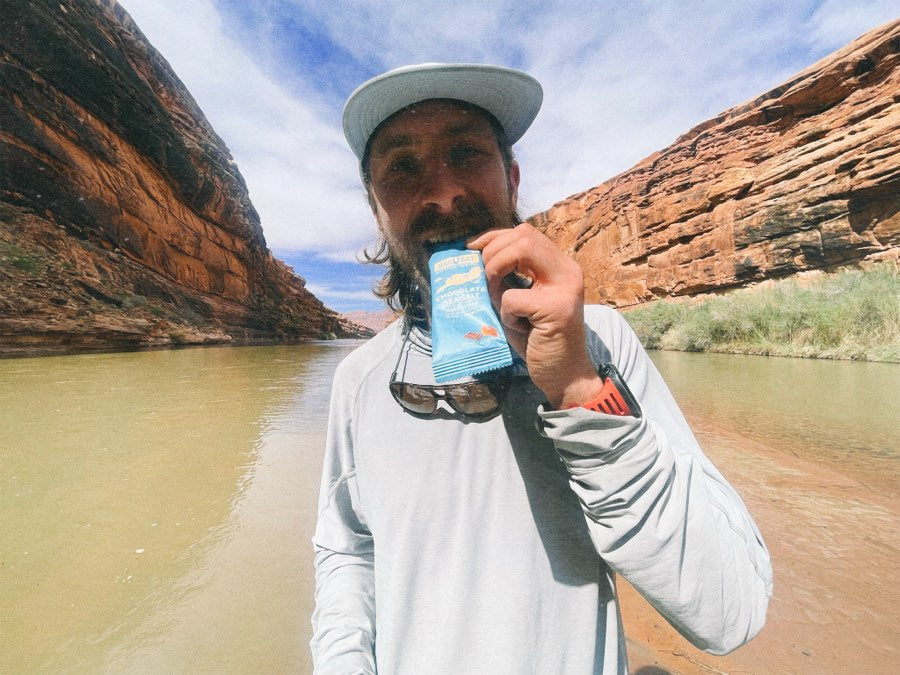
Our co-founder Sam was guiding trips across the West Fjords of Iceland when a local cafe handed him an energy bar unlike anything back home, made from a handful of simple ingredients that actually tasted good. When he got back to Colorado he searched everywhere for something like it, came up empty, and did the only reasonable thing: he made it himself and started selling bars out of the paddleboard shop where he worked.
Turns out people liked them as much as he did. He teamed up with Jason, his childhood best friend, and they named the company after the Bar UE lift at Steamboat Resort. The bars are still made in small batches down the road in Hayden, Colorado, by a company that's owned by the two of them, not by a cereal conglomerate. We're just sayin'.
Flip the label
Here's the entire ingredient list of our Original bar. Not the highlights. The whole thing.
- Organic dates
- Oats
- Pecans
- Almonds
- Pumpkin seeds
- Honey
- Chia seeds
- Flax seeds
- Vanilla
- Salt
Other bars
- Fillers, preservatives, and processed additives
- Quick sugar high, then the crash
- Chalky, bland, or artificial-tasting
- Owned by cereal conglomerates
Bar U Eat
- Simple, whole-food ingredients
- Steady energy from a 4:1 carb-to-protein ratio
- Soft and chewy, yet still crunchy
- Owned by Sam and Jason
No oils, no preservatives, no sweeteners, no fillers. Every ingredient is certified organic, non-GMO, and gluten-free. And when you're done, the wrapper is plant-based and industrial compostable (ASTM D6400 certified). It breaks down in under 84 days at a commercial compost facility, not on the trail, so pack it out like everything else. Nothin' weird inside, nothin' wasteful outside.
One thing we won't claim is vegan. There's honey in these bars, and the bees did great work.
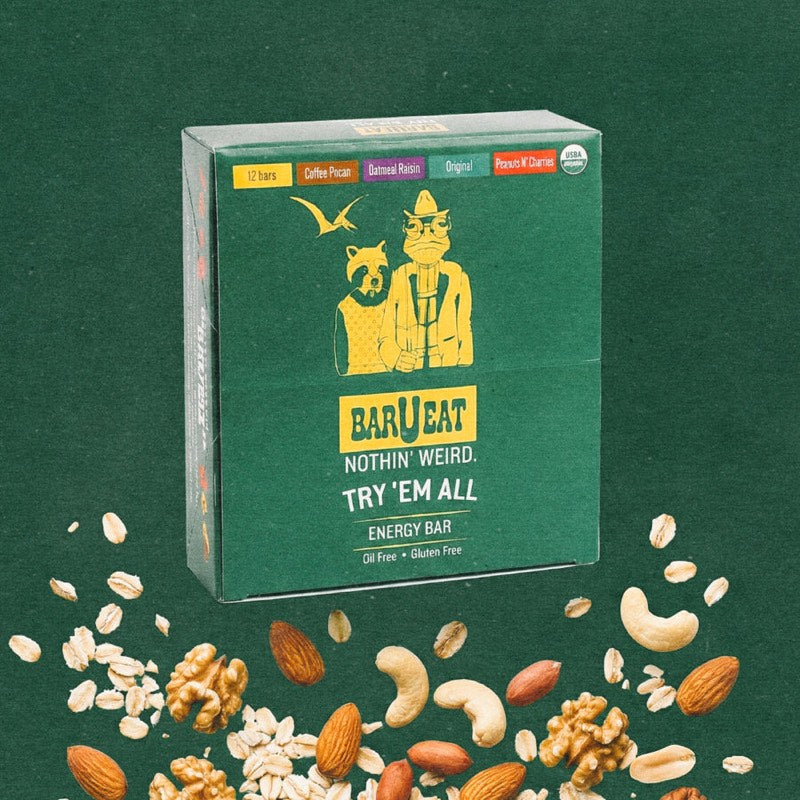
The Try 'Em All Box
Join the Movement.
Carbs are back.
12 bars, four flavors, and a fair shot at finding the one you'll defend at the next protest. Saddle up, partner.
- 3 bars each of Original, Coffee Pecan, Oatmeal Raisin, and Peanuts N' Cherries
- Certified organic, gluten-free, and non-GMO
- 4:1 carb-to-protein ratio, 0 added sweeteners
- Industrial-compostable wrappers (ASTM D6400)
$39.95 That's $3.33 a bar
Grab a BoxFree shipping on orders $49+